
New Telescope First Light: Seeing M51 in a New Way
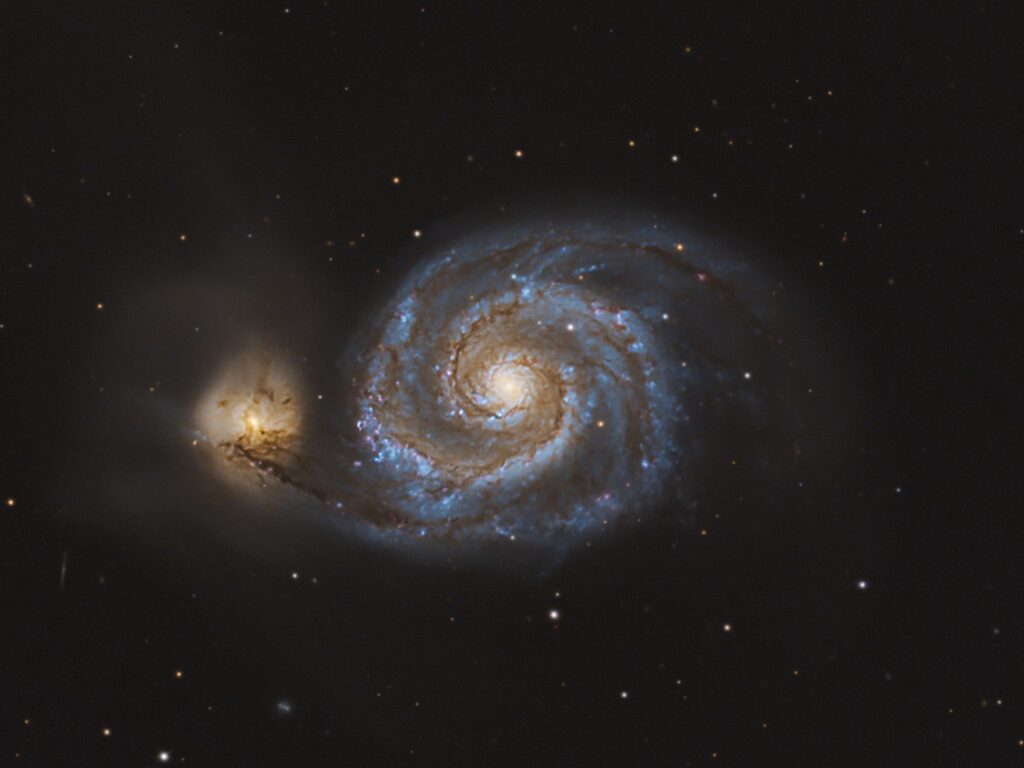
This image marks first light with my new telescope, the Celestron EdgeHD 800, an 8-inch Schmidt-Cassegrain designed for longer focal length imaging. With a native focal length of 2000mm, and about 1422mm using a 0.7x reducer, this setup operates in a very different range than my previous Redcat 61 telescope (300mm). It’s built to resolve smaller targets with higher precision, using a flat-field optical design that keeps stars sharp across the entire frame. It also gathers over 2.5x more light than a typical 60mm refractor, which becomes noticeable when working on faint structure. Not Just Zooming In This wasn’t my first time imaging the Whirlpool Galaxy. My earlier image (below) was taken with a RedCat 61 at around 300mm focal length. At that scale, the galaxy obvious but small and blurry. You see the overall spiral shape, the companion galaxy, and the sense that something is happening between them. It’s a very zoomed in sample of the wide-field view. With my new EdgeHD 8” and reducer at about 1422mm, the galaxy fills much more of the frame, revealing detail that wasn’t visible before. It might seem like simple magnification, but it’s really about resolving finer structure. Now the spiral arms aren’t just visible, they’re resolved. Dust lanes begin to cut through the structure. Bright star-forming regions show up as distinct knots instead of blended patches. The bridge of material connecting M51 to NGC 5195 becomes more obvious, making the interaction easier to see. What the Telescope Change Actually Did Switching from a small refractor to a longer focal length reflector changes what you can extract from a target like this. The RedCat 61 excels at wide frame imaging. It captures the scene cleanly and efficiently, especially under less-than-perfect conditions. But it doesn’t have the reach to pull out fine structure in smaller galaxies. The EdgeHD 8” operates in a different range. At over 1400mm, it demands more from tracking, focus, and seeing, but the payoff is immediate. Structure becomes separation. Texture replaces blur. The galaxy starts to break down into individual features rather than appearing as a single object. With this setup, targets that were previously too small to resolve well are now within reach. That opens the door to more galaxy imaging, revisiting past targets with greater detail, and even some planetary work down the line. The Whirlpool Galaxy The Whirlpool Galaxy (M51) stands out among galaxies for its clearly visible spiral structure and its interaction with a nearby companion galaxy. Located about 23 million light-years away in the constellation Canes Venatici, sitting just above the asterism of the Big Dipper’s handle, it was first recorded by Charles Messier in 1773. Two sweeping arms wrap around a bright core, with a smaller companion galaxy, NGC 5195, hanging just off one side and gravitationally tugging at those arms. What Gives M51 Its Structure M51’s shape comes from its ongoing interaction with NGC 5195. As the smaller galaxy moves around it, it pulls on the stars and gas, organizing them into the spiral pattern we see. Those arms aren’t fixed structures. They’re regions of compression moving through the galaxy, where gas gets squeezed and new stars form. The bluish regions scattered along the arms are clusters of young, hot stars. The reddish patches are hydrogen gas clouds, known as HII regions, where new stars are actively forming. Across the image, you’re seeing different stages of stellar evolution playing out over tens of thousands of light-years. Plenty of new images to come with the new telescope!
Beyond the Belt: Exploring Orion’s Nebulae
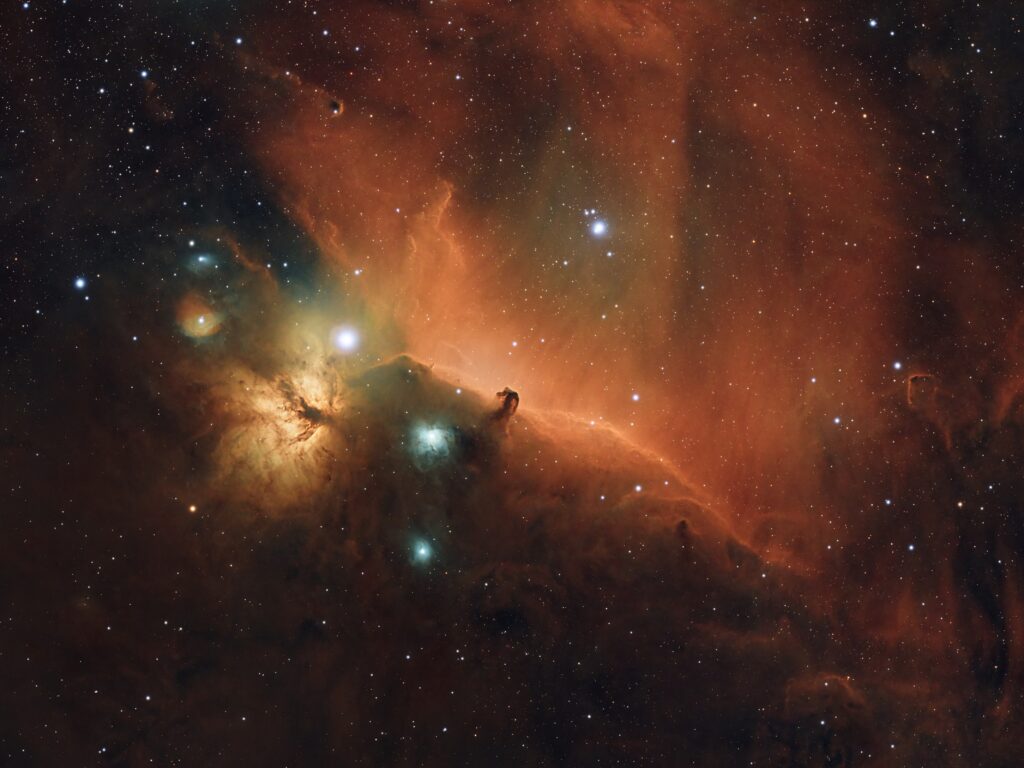
The Orion constellation is easy to recognize, marked by three bright stars forming its belt and a “sword” hanging below. What’s less obvious is that this small patch of sky is packed with a variety of nebulae. That sword is home to the Orion Nebula (M42), a stellar nursery that prominently shows glowing emission gas, reflected starlight, and lanes of dark dust all in one region. Orion Nebula The Orion Nebula (M42) is one of the few deep-sky objects visible to the naked eye. Even under light-polluted skies, it can still be seen below Orion’s belt as a faint, slightly fuzzy patch rather than a sharp point of light. At roughly 1,300 light-years away, it’s relatively close on a galactic scale, and its intense star formation makes it unusually bright. M42 is primarily an emission nebula, where hot, young stars energize surrounding hydrogen gas, causing it to glow. Imaging this object typically requires a blend of exposure times, with short exposures capturing detail in the dense, active core and longer exposures revealing the fainter structure of the surrounding nebula. Right next to the Orion Nebula sits the Running Man Nebula (NGC 1977). The Running Man is a good example of how Orion offers variety of nebulae: compared with the Orion Nebula’s strong glow, the Running Man is largely a reflection nebula, where dust is lit by nearby stars and scatters their light back toward us. When both targets land in the same image, you can point out two different mechanisms side-by-side: glowing gas in one area, and externally lit dust in another. Horsehead Nebula The Horsehead Nebula highlights a third mechanism: the power of dust to block light. The Horsehead looks dark not because it’s empty, but because a dense, cold cloud sits in front of a brighter background. In this case, the backdrop is IC 434, and the Horsehead stands out as a silhouette. That silhouette effect is why it remains one of the most recognizable shapes in deep-sky astrophotography. When you frame the Horsehead region wide enough, as in the image above, the Flame Nebula (NGC 2024) often comes along for the ride. The Flame is an emission nebula and active star-forming region, so it brings that “glowing gas” look back into the same field as the Horsehead’s dark dust. It’s a great contrast in one shot, with bright structure right next to the dark silhouette of the Horsehead. All of these targets sit in or near the Orion Molecular Cloud Complex, a nearby region of star-forming gas and dust that runs through Orion’s Sword and Belt. To capture that full structure, I’d need a much wider field of view than my current setup allows, but it’s definitely something I plan to image in the future. Witch Head Nebula The Witch Head Nebula (IC 2118) is a separate Orion-area target, and it stands out for a different reason. It’s a reflection nebula illuminated mainly by the bright star Rigel, and it’s very faint. Instead of glowing on its own, the dust is reflecting starlight, which is why it appears blueish grey. That blue color comes from the way dust scatters shorter wavelengths of light more efficiently. My Favorite Constellation Taken together, these targets are a good snapshot of how nebulae actually behave. The Orion Nebula shows energized gas and active star formation. The Running Man adds reflected starlight. The Horsehead shows how dust can block and shape what’s behind it. The Flame brings back emission, but with strong dust structure layered through it. And the Witch Head, sitting off near Rigel, rounds things out as a faint reflection target that takes more time and care to capture. Orion keeps pulling me back for two simple reasons. It’s not just one target, and each structure is a lot of fun to capture. It’s a compact region where glowing gas, cold dust, and young stars all show up together, each revealing a different part of how these regions form and evolve. Every year I come back to improve my images, and there’s still more to capture, including the full molecular cloud complex. If you want to see exactly where these images fall within Orion, head over to the sky chart.
Celestial Photobomb: Vesta and the Monkey Head Nebula
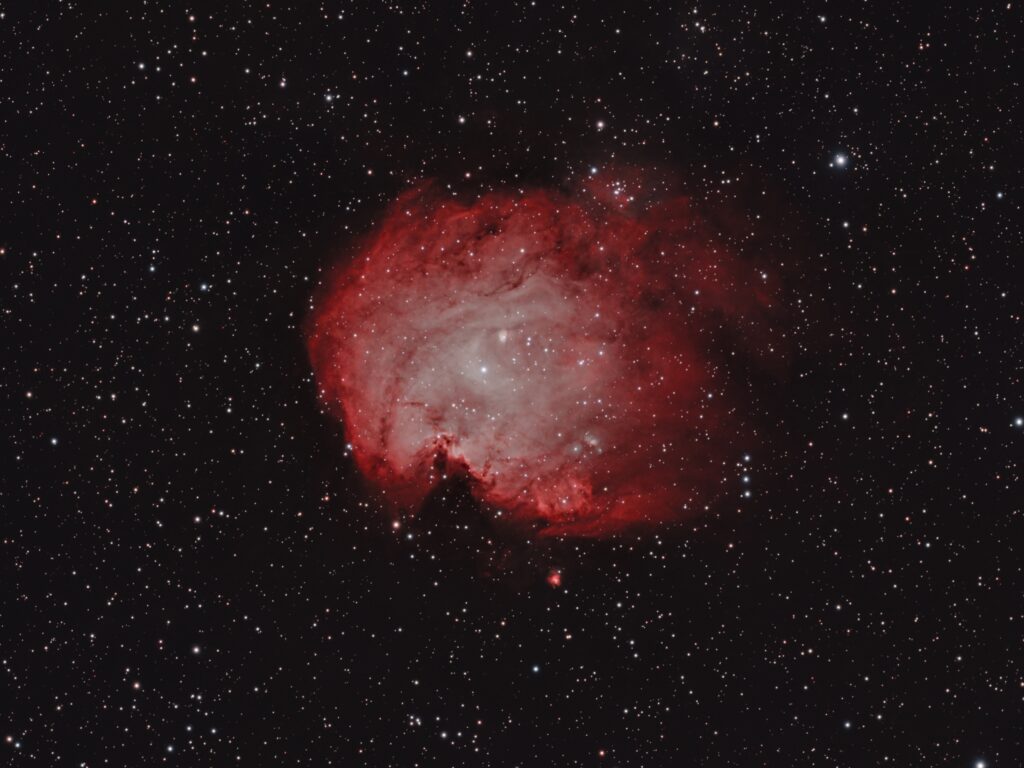
I set out to capture the Monkey Head Nebula (NGC 2174 in Orion) with my usual astrophotography setup, aiming for a gorgeous deep-sky image. I took 70 frames at 300 seconds each (about 6 hours total exposure) and stacked them to reveal the nebula’s faint details. However, something unexpected showed up: a bright object had drifted across those frames, leaving a streaky trail in the combined image. It turns out I had been photobombed by none other than asteroid Vesta – a hefty rock from the asteroid belt that wandered through my field of view. Asteroids actually wander into my astrophotos fairly often. Normally, though, they’re just faint streaks that don’t make it through image stacking. When I stack dozens of long exposures in PixInsight, the software uses pixel-level rejection to clean up things that don’t belong — like satellites, planes, cosmic rays, and yes, small asteroids. It’s like a smart “cosmic eraser.” But Vesta is big and bright! Being one of the brightest asteroids in the sky, the statistical cleanup process could not hide it. Instead of vanishing in the stack, it left a glaring smudge right across my carefully planned nebula shot (see below!). At first, I wasn’t sure what the odd smudge on my stacked image was. It didn’t match any celestial object I’d seen before, and it wasn’t part of the Monkey Head Nebula. To investigate, I used a feature in my processing software that flips through each individual frame like a stop-motion video (see below). Sure enough, I spotted a “star” creeping across the field, moving in a totally different direction than the background stars. That’s when it clicked — I had an asteroid in my shot. The smudge on the stacked image is the software’s failed attempt to remove the “unwanted” object. A quick check online for that date, time, and location confirmed it: I had captured Vesta, one of the brightest and largest asteroids in our night sky! This asteroidal intruder is a fascinating object in its own right, deserving of the attention it grabbed. So, here are some cool facts about Vesta, the photobombing asteroid: Meet Vesta, the Nebula Photobomber NASA’s Dawn spacecraft captured this full-color view of asteroid Vesta during its year-long orbit from 2011–2012. Dawn was the first mission to orbit two different bodies in the asteroid belt — Vesta and later dwarf planet Ceres — giving us unprecedented close-up looks at these building blocks of the early solar system. (NASA Planetary Data System) Vesta Facts: Final Image In the end, what started as a messed-up nebula image turned into a fun discovery. Vesta’s cosmic photobomb was a great reminder that when you’re aiming your telescope at the deep sky, you never know what you might find! In the end, I was able to “photoshop” out the asteroid-smudge so the final image of the Monkey Head Nebula looks clean (below). But I’ve always been more excited to share the short GIF of Vesta floating by!
Galaxy Portraits: A Collection of Distant Worlds
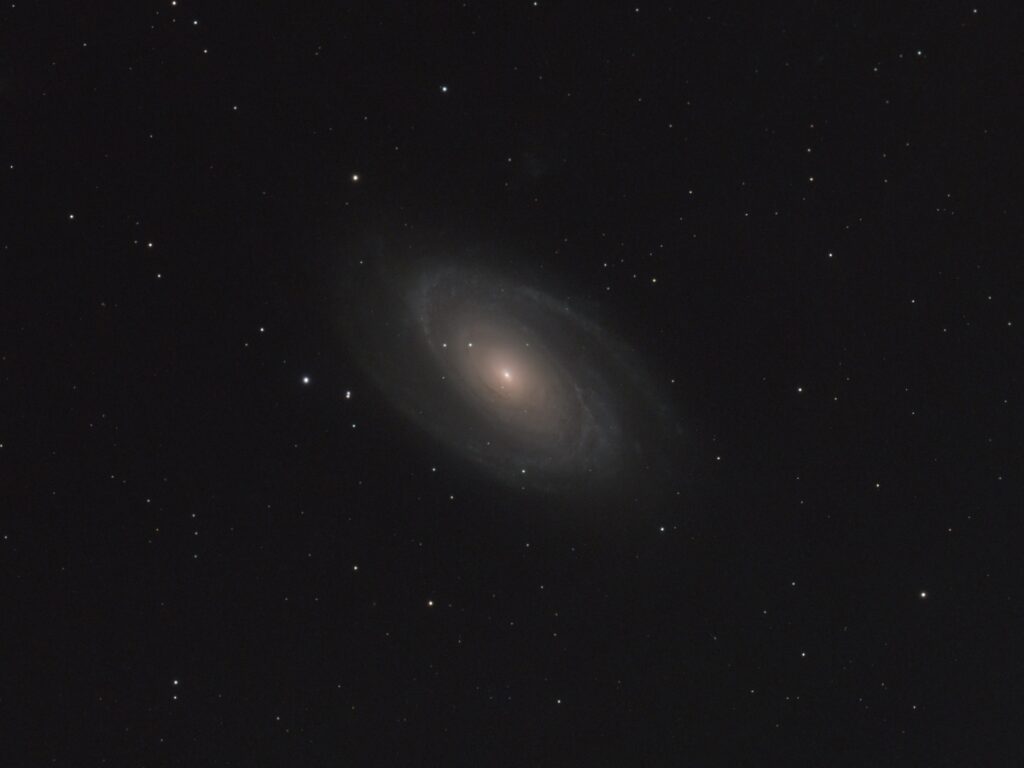
Galaxies I’ve Captured Over the Past Two Years I don’t have the ideal telescope focal length for imaging tiny galaxies. My current setup is a wide-field telescope, which is great for big nebulae but makes most distant galaxies appear small. In the future I plan on adding a longer focal length scope to get closer, more detailed views. For now, I’m excited to share the smaller galaxies I’ve imaged over the past two years with my modest astrophotography rig. All these photos were taken with the same equipment – see my section on equipment for more detail – and in my backyard under suburban skies. Despite the challenges, each galaxy revealed some of its unique details after careful long exposures and stacking. Galaxies come in a variety of types and sizes, and this collection covers a broad sample. You’ll see spiral galaxies (like M51 and M81) which are rotating disks of stars with winding arms, an elliptical galaxy (M84 in Markarian’s Chain) which is a more rounded system of older stars with little new star formation, and even a starburst galaxy (M82) undergoing intense stellar production. There are also interacting galaxies tugging on each other gravitationally, and entire galaxy groups and clusters (Markarian’s Chain in the Virgo Cluster, and the distant Leo Cluster). The sections below breakdown a variety of different galaxies I captured along with some interesting facts and notes on the imaging process. Enjoy! Messier 51 – The Whirlpool Galaxy The Whirlpool Galaxy (Messier 51), is a face-on spiral galaxy famous for its well-defined spiral arms. It lies about 23–31 million light-years away in the constellation Canes Venatici. M51 is a grand-design spiral galaxy – one with prominent and well-defined spiral arms- with a smaller companion galaxy, NGC 5195, tugging at one of its arms. With an apparent magnitude of about 8.4, M51 is bright enough that amateur astronomers can spot its fuzzy glow even in smaller telescopes, so it’s a favorite target for observers and astrophotographers. M51’s spiral arms owe much of their prominence to the gravitational dance with NGC 5195, which is triggering star formation as the two galaxies interact. My wide-field image of M51 doesn’t show individual stars, but the classic two-arm “whirlpool” shape is clearly visible after stacking long exposures. This galaxy’s relatively high surface brightness makes it one of the more forgiving small-galaxy targets to photograph with modest equipment. Still, I look forward to revisiting the Whirlpool Galaxy with a higher magnification setup to reveal finer details in its spiral arms. Messier 81 – Bode’s Galaxy Bode’s Galaxy (Messier 81), is a grand-design spiral galaxy in Ursa Major (aka The Big Dipper). At roughly 11–12 million light-years from Earth, it’s one of the nearest big galaxies beyond our Local Group. M81 spans about 96,000 light years in diameter, similar in size to the Milky Way. This galaxy has a bright nucleus that harbors a supermassive black hole. Thanks to its large size, relative proximity, and overall brightness (around magnitude 6.9), M81 has been studied extensively by professional astronomers and is another popular target. Through my equipment, M81 sits in the same field of view as its companion galaxy M82 (the Cigar Galaxy) mentioned below, and the two have interacted gravitationally in the past. I captured M81 in the spring season when Ursa Major was high in the sky, giving me the best chance at sharp images. I took over 500 five-minute exposures or 40 hours of exposure time over nine nights to stack and produce the image above. It was still a challenge to edit the image. After failing in 2023 and 2024 to produce an image I was happy with, I tried again in 2025 with more exposure time and better editing experience. I was finally able to draw out some of the faint outer spiral arms and show the galaxy’s yellowish core and bluish arms. Messier 82 – The Cigar Galaxy The Cigar Galaxy (Messier 82), is a starburst galaxy also located in Ursa Major, only about 12 million light-years away – essentially next-door to M81. Unlike the grand spiral form of its neighbor, M82 appears as a distorted, edge-on cigar-shaped glow. It is undergoing a frenzy of star formation. Astronomers believe this burst of star formation was triggered by a past close encounter with M81. The gravitational interaction compressed gas in M82, igniting rapid stellar birth. As a result, M82 is about 5 times more luminous than our entire Milky Way despite being much smaller. It’s the prototypical starburst galaxy, with winds of gas blowing out from its core – images in hydrogen-alpha often show reddish plumes from supernova-driven winds. Notably, M82 hosted a bright supernova (SN 2014J) discovered in 2014, and even more recently, in 2020-2023, it’s been the source of unusual flashes like an ultra luminous pulsar and a magnetar flare, highlighting the extreme conditions in this galaxy. In my photograph, M82 appears as a slender, elongated smudge. Pulling out detail in M82 is challenging with a wide-field scope because it’s quite small (about 11′ by 4′ arcminutes in size – Ill do a post on this later!). However, with enough exposure I could enhance the contrast to reveal an orange-reddish hue in the core (indicating the starburst regions rich in hydrogen). This photo of M82 was taken at the same time and within the same frame as M81 above – a total of 40 hours of exposure time. The galaxy’s patchy structure and the dark dust lane bisecting its center became visible. Barely visible is the faint reddish outflow coming from the core (the supernova-driven wind). M82’s high surface brightness helped; at about magnitude 8.4 it stands out well against the background sky. This galaxy, though small in my frame, is one of the most active and interesting objects I’ve imaged, due to its intense star-forming activity and gravitational interaction with M81 nearby. Messier 104 – The Sombrero Galaxy Though very small with my scope, the Sombrero Galaxy (M104), is one of my favorite objects Ive
The Veil Nebula: A Massive Star’s Explosive Legacy
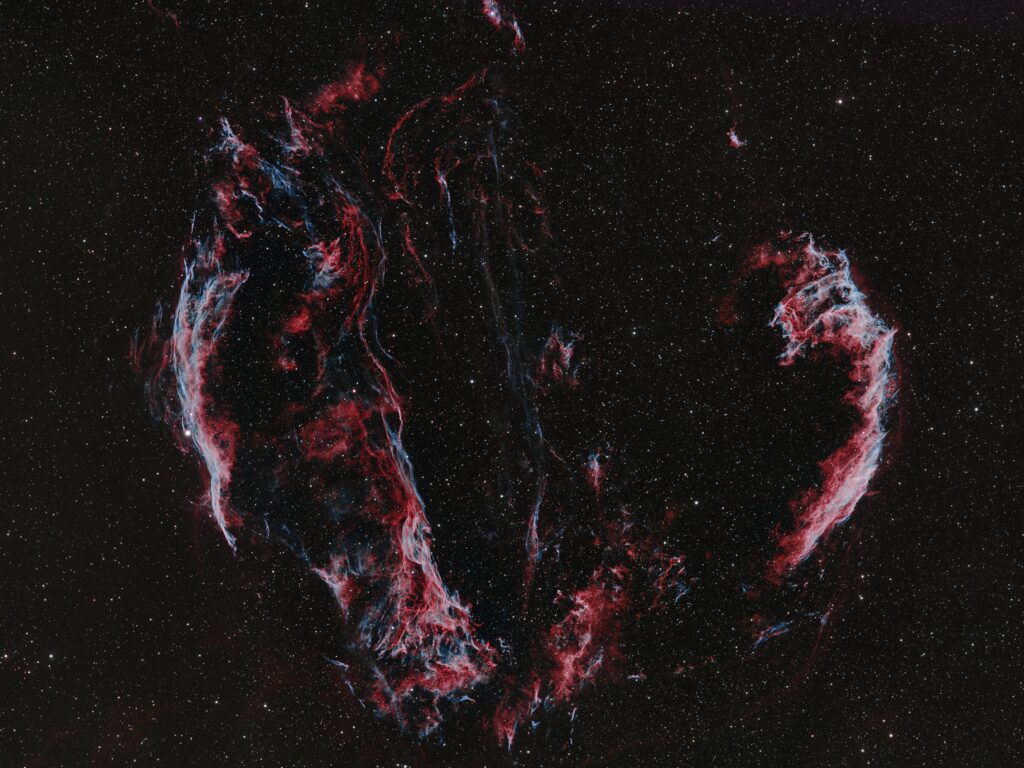
The Veil Nebula is a supernova remnant in the constellation Cygnus (the Swan). It represents the visible remains of a star that exploded in a supernova thousands of years ago. This vast nebula stretches across an area of sky about 3 degrees in diameter – roughly six times the apparent diameter of the full Moon – making it a large but very faint object in the night sky. This was one of my first targets as an amateur astrophotographer and a challenge to process. Learn more below! Target Details Constellation: Cygnus Distance: 2,400 light years Diameter: 220,000 light years Magnitude: 7.0 Apparent Size: 3.0° x 2.5° RA 20h 45m 38s, DEC +30° 42′ 30″ Shot Details Dates: October 2023 Integration: 116 x 300″ Total Time: 9h 40′ Telescope: Redcat 61 Camera: ASI 2600mc pro Mount: AM5 About the Target The Veil Nebula, also known as the “Cygnus Loop,” is located about 2,400 light-years from Earth and stretches roughly 110 light-years across. What you’re seeing is the expanding debris from a massive star that exploded long ago in a supernova. Even though the nebula is enormous and gives off a good amount of light overall, it’s so spread out that it looks pretty faint in the sky. It was first discovered back in 1784 by astronomer William Herschel — using a reflecting telescope he built himself! The Veil Nebula’s Main Components The Veil Nebula is not a single, uniform cloud, but rather a complex of intertwined nebulae forming different parts of the supernova’s blast wave. Over time, astronomers have identified and named several main components of the Veil Nebula, each corresponding to a bright section of the glowing supernova remnant. The most prominent components are the Western Veil, the Eastern Veil, and Pickering’s Triangle. The Western Veil – “Witch’s Broom Nebula” The Western Veil Nebula (NGC 6960) is often called the “Witch’s Broom” because in photographs it resembles a witch’s broom sweeping through the stars (flipped on the right to the broom “rotation”). This portion appears as a long, slender filament of light stretching roughly north-south on the western side of the Veil complex. A bright 4th-magnitude star named 52 Cygni lies in front of this nebula, but it is not physically related to the nebula. The Western Veil’s filamentary structure consists of fine strands of ionized gas, primarily oxygen and hydrogen. More on the color soon! Its shape is the result of the shock wave from the exploded star expanding through interstellar space, compressing and lighting up the gas. The Western Veil extends nearly a degree in length across the sky. In visual telescopes, this part can be seen as a faint, narrow ribbon of light that stands out well when using filters. The intricate structure and vibrant colors make for an amazing astrophotography target! The Eastern Veil Nebula On the opposite side of the Veil Nebula lies the Eastern Veil, a slightly brighter and denser region of glowing gas. Compared to the Western Veil, this section has a thicker band of nebulosity with more tangled, overlapping threads. These threads are part of the same enormous shockwave from a long-ago supernova — we’re just seeing it from a different perspective. Imagine the explosion as a giant sphere expanding in all directions. Depending on where we’re looking from here on Earth, we’re seeing different parts of that shell from different angles. The Western Veil shows us the edge of the wave, almost like looking at a ripple from the side. But with the Eastern Veil, we’re peering more directly into a section where the shockwave is curving toward or away from us, making the filaments appear more layered and complex. That’s why this region looks more chaotic. Near the top of this section, there’s a feature often nicknamed the “Bat Nebula” because of its shape — it almost looks like a bat with outstretched wings. Altogether, the Eastern Veil spans over a degree of the night sky, which is about twice the width of the full moon as seen from Earth. Pickering’s Triangle Between the prominent eastern and western arcs lies a fainter web of nebulosity known as Pickering’s Triangle. Pickering’s Triangle was first noticed in 1904 on photographic plates taken at Harvard College Observatory. The discovery was made by astronomer Williamina Fleming, but following the custom of the time, it was credited to the observatory director Edward Pickering (hence the name “Pickering’s Triangle”). Pickering’s Triangle appears as a triangular or wedge-shaped network of filaments. It is more subtle than the main east and west arcs, but in long exposures it reveals a stunning tangle of fine, hair-like strands of gas. In images, this region tends to show a mix of soft reds and blues similar to the rest of the Veil, indicating hydrogen and oxygen emissions. Visually, Pickering’s Triangle is the most challenging of the three main sections to observe because of its lower surface brightness, but under dark skies and with a good telescope filter, dedicated observers can trace some of its faint wisps. Other Structures While the Eastern and Western Veil and Pickering’s Triangle are the most famous parts of the nebula, they’re many more small structures. The Veil is filled with many other filaments and small glowing knots scattered across the structure — like the Southeastern Knot, which I annotated above. These aren’t as bright or well-known, but they’re all part of the expanding debris field. Most are little fragments or dense patches of gas that lit up as the shockwave passed through. Think of the Veil Nebula as a giant, hollow bubble from a supernova explosion, the bright filaments are like the edges of that bubble seen from the side. The shockwave isn’t expanding perfectly evenly — some areas hit thicker clouds of gas and light up more brightly, while others drift into emptier space and fade out. The end result is this intricate web of glowing threads spread across the sky, all forming what we call the Cygnus Loop. The Explosive Origin As beautiful
Andromeda Galaxy Astrophotography: Neighbor to the Milky Way
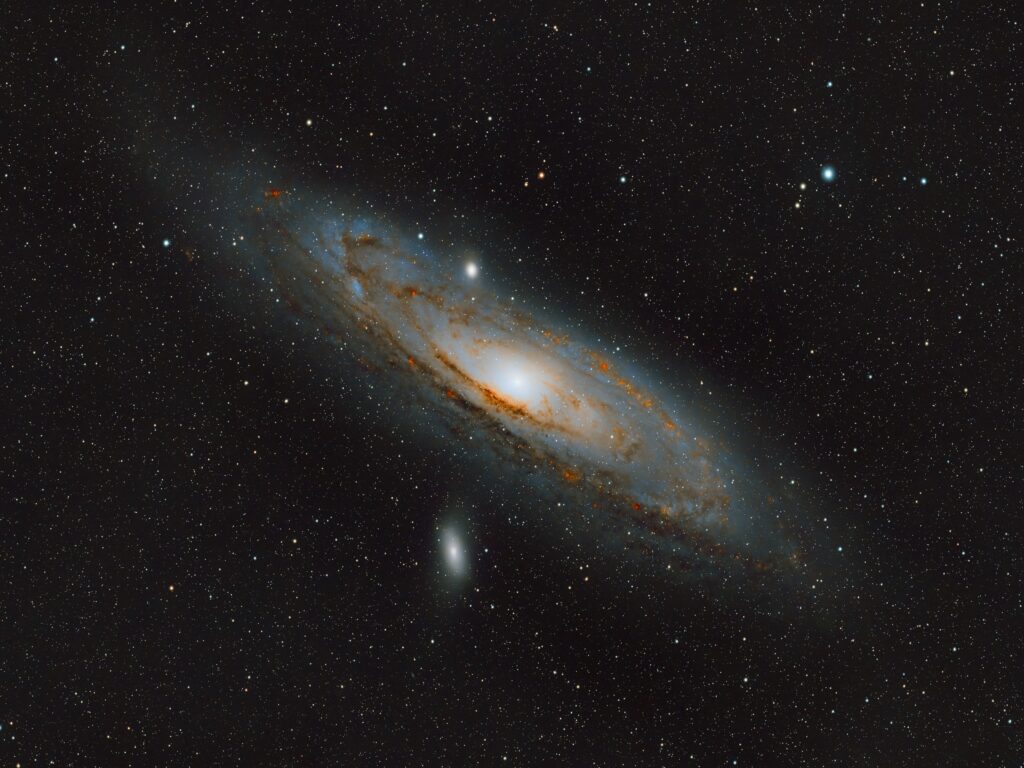
One of my first deep sky objects to image, the Andromeda Galaxy (M31) is the closest spiral galaxy to our own and on a slow-motion collision course with the Milky Way! I captured this image over several nights, stacking hours of exposure time to bring out the fine details of its spiral arms and glowing core. Target Details Constellation: Andromeda Distance: 2.54 million light years Diameter: 220,000 light years Magnitude: 3.4 Apparent Size: 3.2° x 1° RA 00h 42m 44s, DEC +41° 16′ 06″ Shot Details Dates: October 2023 Integration: 158 x 300″ Total Time: 13h 10′ Telescope: Redcat 61 Camera: ASI 2600mc pro Mount: AM5 About the Target Andromeda is an excellent target due to its impressive size in the sky. Surprisingly, from our perspective, it appears four times larger than the full Moon. However, its faint glow makes it difficult to see its sprawling spiral arms with the naked eye. Through long-exposure photography, its stunning structure comes to life, revealing intricate details and the grandeur of this magnificent galaxy. The Andromeda Galaxy (M31) is on a “slow” (244,800 mph) but inevitable collision course with the Milky Way, a cosmic event set to unfold in approximately 4.5 billion years. As the two galaxies are drawn together by gravity, they will engage in a spectacular merger, reshaping their structures and forming a new, larger galaxy. While this may sound catastrophic, Earth itself is unlikely to be directly affected. The vast distances between stars mean that actual collisions between them are improbable. However, the night sky will dramatically change over millions of years, with Andromeda appearing larger and brighter until the galaxies finally blend into one. Visible in my image are some of Andromeda’s most notable satellite galaxies, including Messier 32 and Messier 110. M32 appears as a small, bright elliptical galaxy nestled just above the core of Andromeda, while M110 is seen below Andromeda as a blurry, elongated satellite. These dwarf galaxies, along with others like NGC 147 and NGC 185, are slowly being influenced by Andromeda’s immense gravitational pull and may eventually be absorbed into its structure. Long-exposure astrophotography like this reveals the incredible details of these galaxies, making their presence and interaction with Andromeda all the more striking. The Andromeda Galaxy (M31) is one of the most exciting and rewarding targets for astrophotography, and it was actually one of the first deep-sky objects I ever captured. Its massive size and relatively bright core make it an ideal subject, even for beginners. Unlike many distant galaxies that require large telescopes and dark skies, Andromeda is bright enough to be photographed with a modest setup, making it a common target in the astrophotography community.