
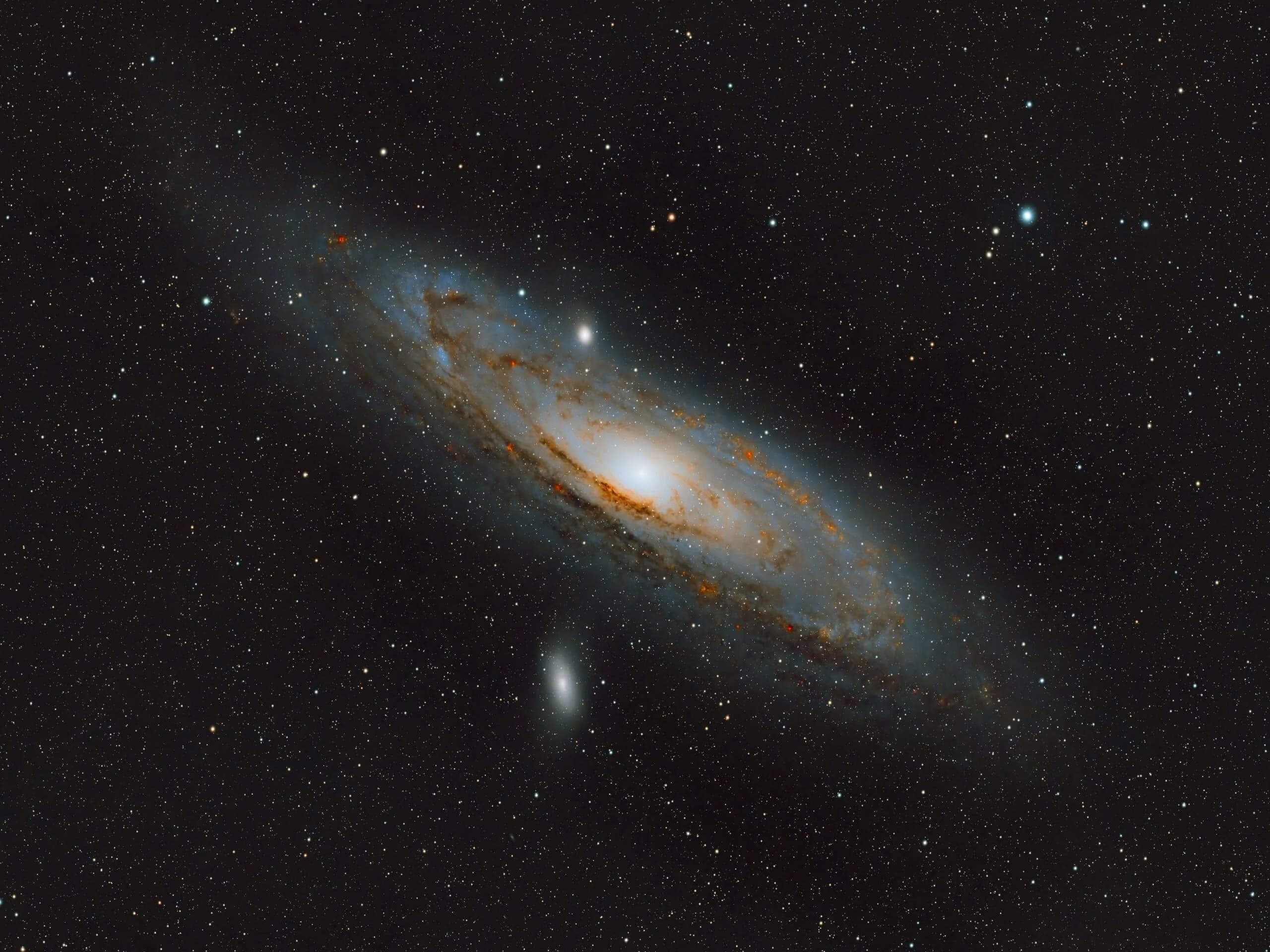
The Andromeda Galaxy (M31) was one of my first deep-sky imaging targets. I captured it over several nights, stacking hours of exposure time to reveal its spiral structure, dust lanes, and glowing core.
About the Target
Andromeda is an excellent target due to its impressive size in the sky. Surprisingly, from our perspective, it appears four times larger than the full Moon. However, its faint glow makes it difficult to see its sprawling spiral arms with the naked eye. Through long-exposure photography, its stunning structure comes to life, revealing intricate details and the grandeur of this magnificent galaxy.
The Andromeda Galaxy (M31) is on a "slow" (244,800 mph) but inevitable collision course with the Milky Way, a cosmic event set to unfold in approximately 4.5 billion years. As the two galaxies are drawn together by gravity, they will engage in a spectacular merger, reshaping their structures and forming a new, larger galaxy. While this may sound catastrophic, Earth itself is unlikely to be directly affected. The vast distances between stars mean that actual collisions between them are improbable. However, the night sky will dramatically change over millions of years, with Andromeda appearing larger and brighter until the galaxies finally blend into one.
Visible in my image are two of Andromeda's most notable satellite galaxies, Messier 32 and Messier 110. M32 appears as a small, bright elliptical galaxy near Andromeda's core, while M110 appears as a fainter, elongated companion. Long-exposure imaging makes these satellites and their relationship to the larger galaxy much easier to see.
Andromeda's enormous apparent size and relatively bright core make it a rewarding target for astrophotographers at every experience level. Unlike many distant galaxies that require large telescopes and exceptionally dark skies, it can reveal impressive structure through a modest imaging setup.