
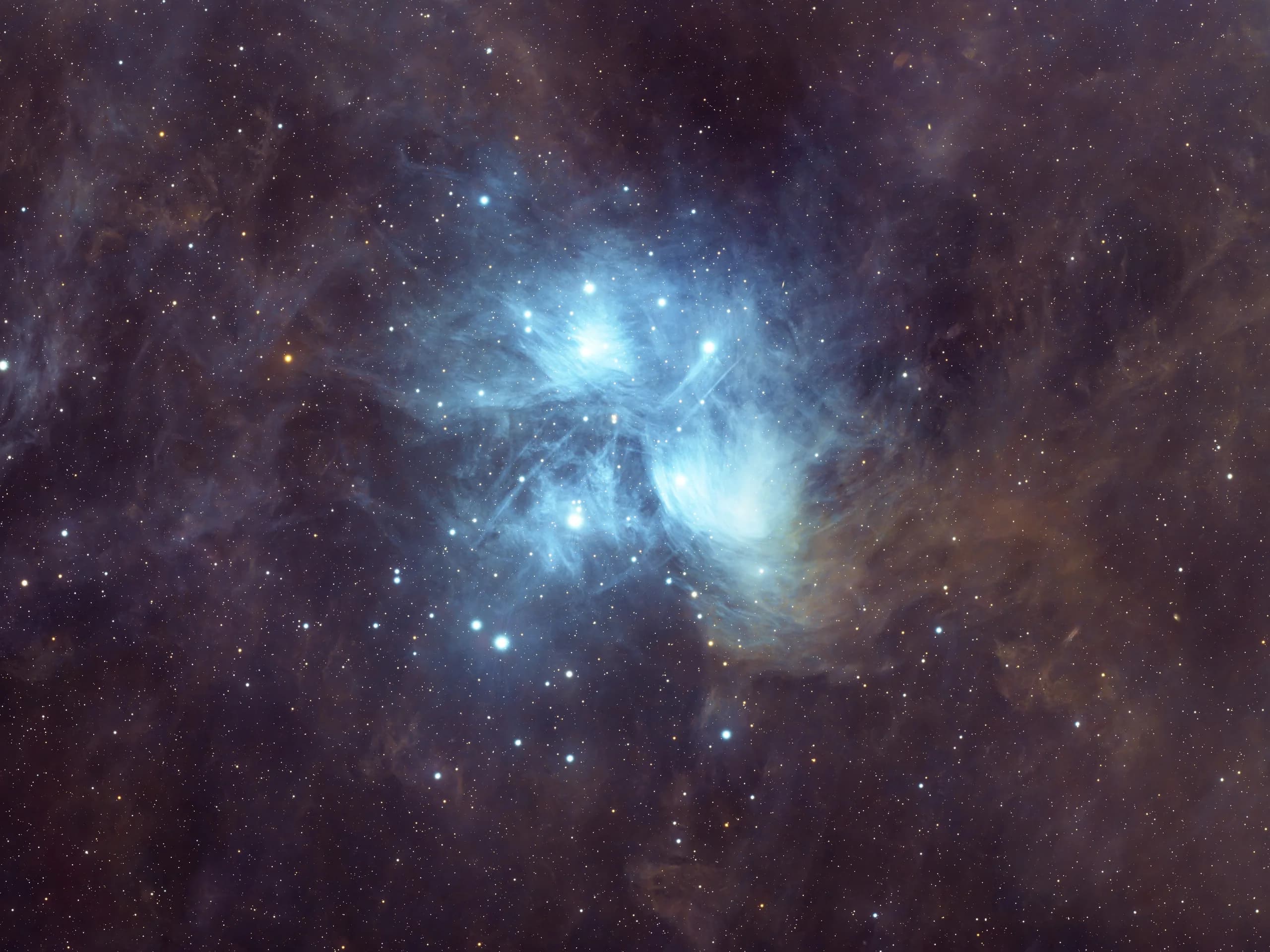
Image evolution
Three versions of the same sky
The Pleiades did not change between these images. The data, framing, and processing did. Move through the versions to see how added exposure time and more deliberate finishing reveal a quieter layer of the scene: dust reflecting the light of young blue stars.
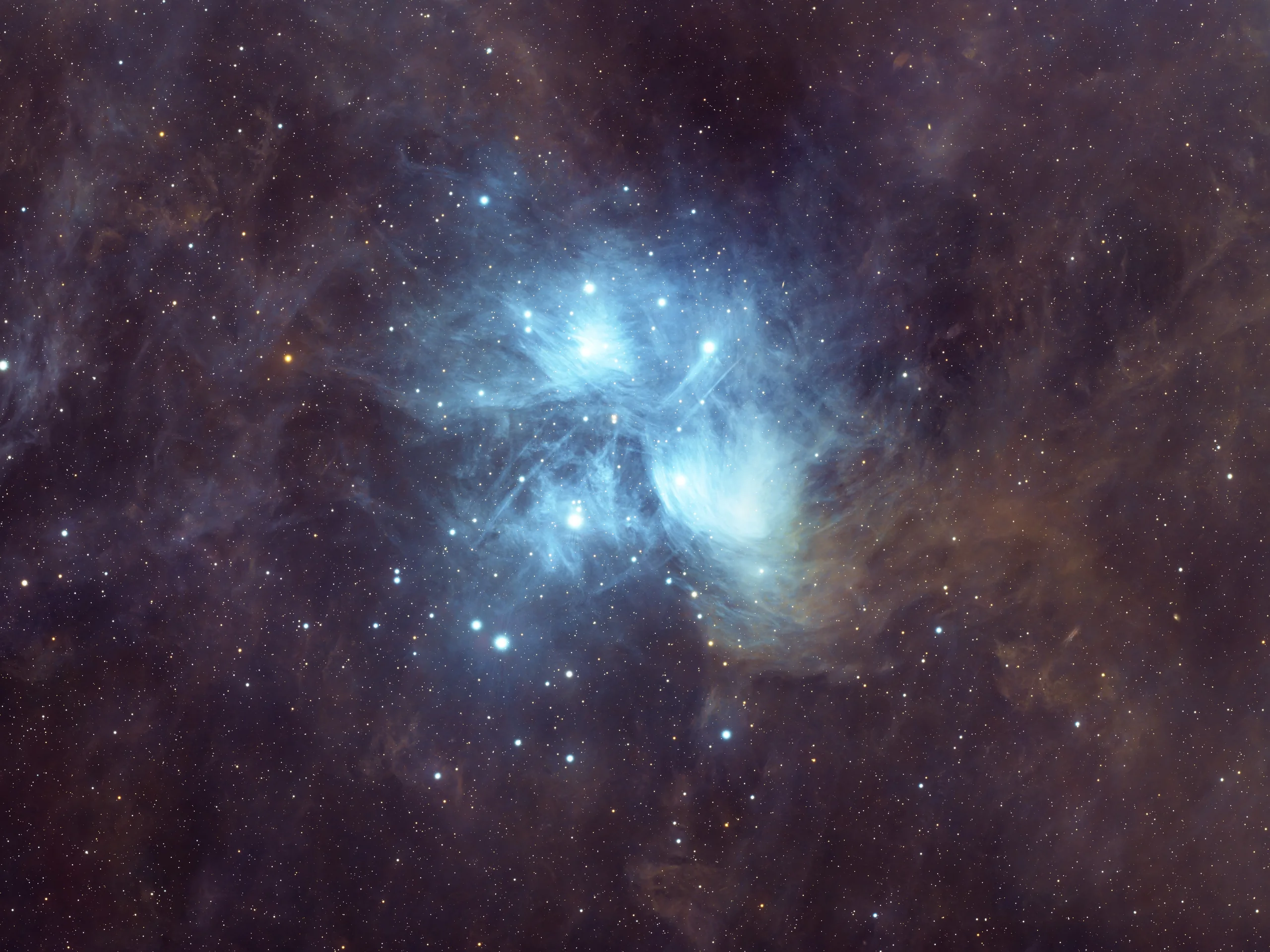
November 2025 final
Preparing the Gaia star field…
The Pleiades are famous for their bright blue stars. The softer blue glow around them belongs to something quieter: dust reflecting the light of those stars back toward us.
This is also an image about learning to see. I have processed the Pleiades more than once, and each version has taught me something different about exposure time, framing, contrast, and restraint. The object stayed the same. My ability to reveal it improved.
The blue is a clue
The Pleiades are an open cluster, which means the stars are a genuine group. They formed in the same broad neighborhood and still travel through the Milky Way together. A few of the brightest members are easy to spot without a telescope, but the cluster contains hundreds of stars. The familiar Seven Sisters are only the brightest part of the family photo.
The blue haze is a different kind of family connection. It is a reflection nebula: a cloud of dust that happens to be passing through the same region of space. The dust does not make its own light the way an emission nebula does. Instead, it scatters and reflects light from the hot blue stars nearby.
The easiest everyday comparison is a flashlight in mist. The flashlight is the source. The mist is what lets the beam show up from the side. Around M45, the stars provide the flashlight and the dust provides the mist. The blue color is a sign that the dust is redirecting the light from those young stars toward us.
The image grew with the data
The 2023 version was the starting point: a recognizable Pleiades, a dark field, and a hint of blue nebulosity. It also showed me where the image was asking for more. The faint dust is easy to lose if the background is pushed too dark, and the bright stars can quickly become too dominant if the processing is too aggressive.
The April 2025 version brought the cluster closer and gave the reflection nebula more room to become part of the composition. The frame feels more intentional because the Pleiades are no longer just a bright knot in a large field. They become the center of a wider cloud of reflected light.
The November 2025 final is the result of continuing the process instead of treating the first good image as the finish line. I added substantially more exposure time, brought together a more complete set of short and longer subs, and worked to keep the background natural. The goal was not simply to make the blue cloud brighter. It was to make its shape easier to read without flattening the field around it.
Dust, light, and depth
The Pleiades are moving through a textured interstellar dust cloud, not sitting inside a neat shell. Tiny grains scatter the young stars' blue light toward us, so some areas glow while others remain faint depending on the cloud's shape and angle. The photograph is flat, but the scene has real depth: stars, dust, and the long path of reflected light are separate layers.
Longer exposure reveals this low-contrast dust while mixed exposure lengths protect the bright stars. The processing works best when it keeps the background natural and the nebulosity looking like light in space rather than a solid blue object. The 3D model above makes that relationship easier to explore, while the three image versions show how deeper data reveals more of the dusty neighborhood.
Learn more
The basic science of the Pleiades and their reflection nebula is explained by NASA's Seven Sisters overview and NASA's TESS study of the cluster.