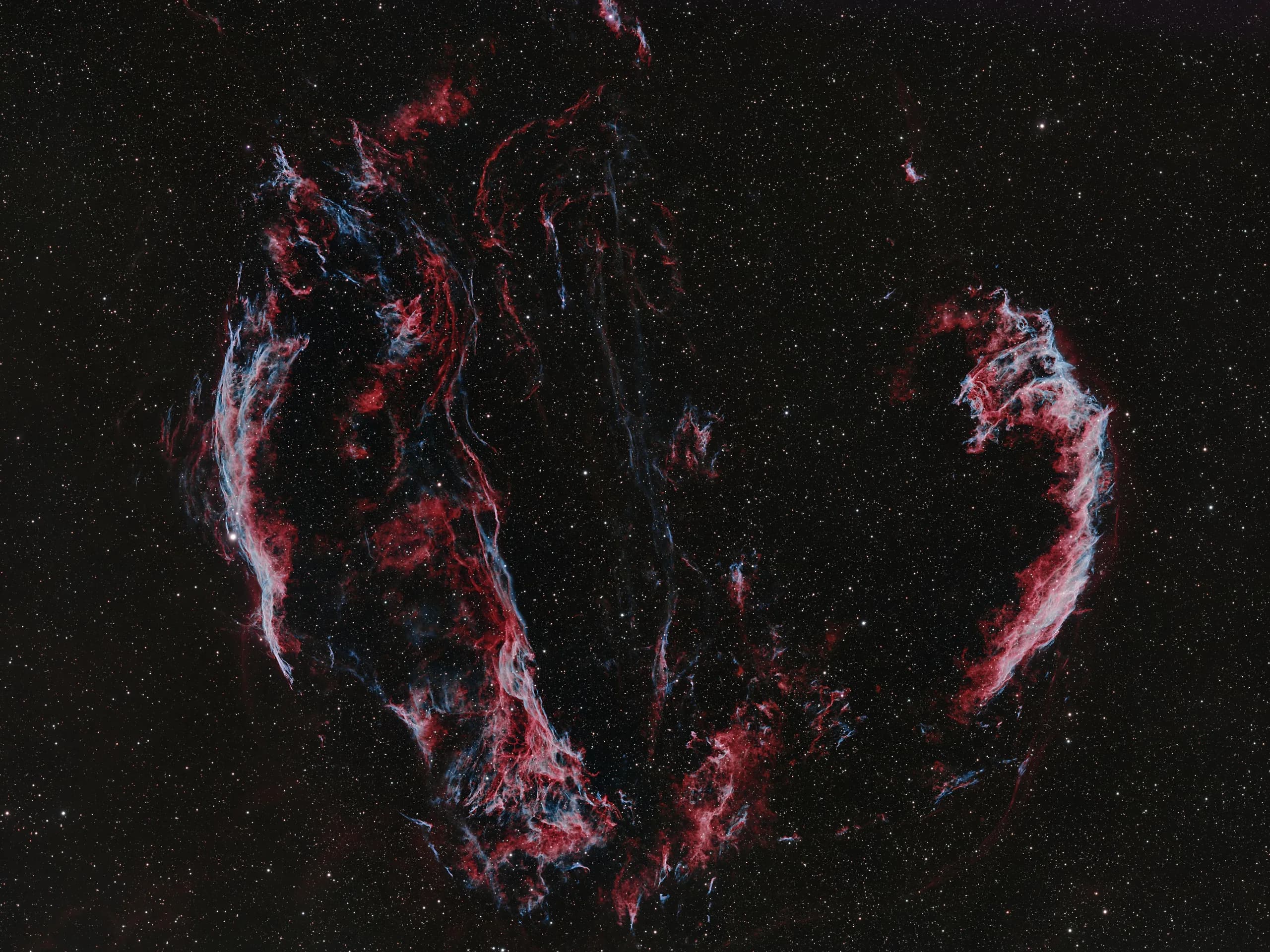
The Veil Nebula is a supernova remnant in the constellation Cygnus (the Swan). It represents the visible remains of a star that exploded in a supernova thousands of years ago. This vast nebula stretches across an area of sky about 3 degrees in diameter - roughly six times the apparent diameter of the full Moon - making it a large but very faint object in the night sky. This was one of my first targets as an amateur astrophotographer and a challenge to process. Learn more below!
About the Target
The Veil Nebula, also known as the "Cygnus Loop," is located about 2,400 light-years from Earth and stretches roughly 110 light-years across. What you're seeing is the expanding debris from a massive star that exploded long ago in a supernova. Even though the nebula is enormous and gives off a good amount of light overall, it's so spread out that it looks pretty faint in the sky. It was first discovered back in 1784 by astronomer William Herschel - using a reflecting telescope he built himself!
The Veil Nebula's Main Components
The Veil Nebula is not a single, uniform cloud, but rather a complex of intertwined nebulae forming different parts of the supernova's blast wave. Over time, astronomers have identified and named several main components of the Veil Nebula, each corresponding to a bright section of the glowing supernova remnant. The most prominent components are the Western Veil, the Eastern Veil, and Pickering's Triangle.
The Western Veil - "Witch's Broom Nebula"
The Western Veil Nebula (NGC 6960) is often called the "Witch's Broom" because in photographs it resembles a witch's broom sweeping through the stars (flipped on the right to the broom "rotation"). This portion appears as a long, slender filament of light stretching roughly north-south on the western side of the Veil complex. A bright 4th-magnitude star named 52 Cygni lies in front of this nebula, but it is not physically related to the nebula.
The Western Veil's filamentary structure consists of fine strands of ionized oxygen and hydrogen. Its shape traces the supernova shock wave as it expands through interstellar space, compressing and energizing the surrounding gas. The Western Veil extends nearly a degree across the sky and appears through a visual telescope as a faint, narrow ribbon that responds well to nebula filters.
The Eastern Veil Nebula
On the opposite side of the Veil Nebula lies the Eastern Veil, a slightly brighter and denser region of glowing gas. Compared to the Western Veil, this section has a thicker band of nebulosity with more tangled, overlapping threads. These threads are part of the same enormous shockwave from a long-ago supernova - we're just seeing it from a different perspective.
Imagine the explosion as a giant sphere expanding in all directions. Depending on where we're looking from here on Earth, we're seeing different parts of that shell from different angles. The Western Veil shows us the edge of the wave, almost like looking at a ripple from the side. But with the Eastern Veil, we're peering more directly into a section where the shockwave is curving toward or away from us, making the filaments appear more layered and complex. That's why this region looks more chaotic.
Near the top of this section, there's a feature often nicknamed the "Bat Nebula" because of its shape - it almost looks like a bat with outstretched wings. Altogether, the Eastern Veil spans over a degree of the night sky, which is about twice the width of the full moon as seen from Earth.
Pickering's Triangle
Between the prominent eastern and western arcs lies a fainter web of nebulosity known as Pickering's Triangle. Pickering's Triangle was first noticed in 1904 on photographic plates taken at Harvard College Observatory. The discovery was made by astronomer Williamina Fleming, but following the custom of the time, it was credited to the observatory director Edward Pickering (hence the name "Pickering's Triangle").
Pickering's Triangle appears as a triangular or wedge-shaped network of filaments. It is more subtle than the main east and west arcs, but in long exposures it reveals a stunning tangle of fine, hair-like strands of gas. In images, this region tends to show a mix of soft reds and blues similar to the rest of the Veil, indicating hydrogen and oxygen emissions. Visually, Pickering's Triangle is the most challenging of the three main sections to observe because of its lower surface brightness, but under dark skies and with a good telescope filter, dedicated observers can trace some of its faint wisps.
Other Structures
Although the Eastern and Western Veil and Pickering's Triangle are the best-known sections, the remnant contains many smaller filaments and glowing knots, including the Southeastern Knot annotated above. These less prominent structures are dense patches of gas energized as the shock wave passed through them.
Think of the Veil Nebula as a giant, hollow bubble created by a supernova. The bright filaments are portions of that shell seen edge-on. The shock wave expands unevenly: denser clouds glow brightly, while thinner regions fade into the background. Together, those threads form the Cygnus Loop.
The Explosive Origin
As beautiful as the Veil Nebula is, it started with a cosmic explosion. A star roughly 20 times more massive than our Sun came to the end of its life and exploded in a supernova. That explosion sent shockwaves blasting outward into space, lighting up everything in their path. Astronomers think it happened somewhere between 10,000 and 20,000 years ago. Based on its distance, the supernova might have been visible from Earth - maybe even brighter than Venus - but it occurred long before anyone was writing that kind of thing down.
Since then, the shock wave has moved through surrounding interstellar gas, heating and energizing it. Much of the visible Veil is not material thrown directly from the star, but gas that was already in space and began glowing as the expanding wave passed through it.
And it's still moving. Using space telescopes like Hubble, astronomers have compared images taken decades apart and have watched the nebula expand in real time. The shockwave is still racing outward at nearly a million miles per hour, though it's slowing down over time. Eventually, it will fade into the background as the gas spreads out and cools.
Interestingly, we haven't found the collapsed core of the star - no obvious neutron star or pulsar like we see in the Crab Nebula, for example. It may exist, but it's either too faint, too hidden, or possibly a black hole we can't see directly.
A Little Science Behind the Color
One of the most striking things about the Veil Nebula is its color. In processing this image, I did stretch the data and boost the saturation a bit (more on that in the Processing Guide), but the hues you see here reflect actual wavelengths of light captured by the camera.
When the shockwave from the supernova hits interstellar gas, it slams into the atoms and heats them up, stripping away electrons. As the atoms cool and those electrons recombine, they emit light at specific wavelengths - kind of like neon signs in space.
- Reds and pinks come from ionized hydrogen (H-alpha emission).
- Blues and greens come from doubly ionized oxygen ([O III]), which is especially noticeable in the Western Veil, giving it a turquoise glow.
- Deeper reds and oranges can come from ionized sulfur and other elements.
These elements - hydrogen, oxygen, sulfur, and others - are the real leftovers of the star or the surrounding space it blew through. And they're important. These same ingredients go on to form new stars, planets, and eventually things like us! So in a way, the Veil Nebula is both an end and a beginning - a dramatic death that helps set the stage for the next generation of the cosmos.
Sources:
NASA. Veil Nebula Supernova Remnant. Hubble Space Telescope, NASA Science. Accessed April 2025. View source.
Robert A. Fesen, Kathryn E. Weil, Ignacio A. Cisneros, William P. Blair, and John C. Raymond. "The Cygnus Loop's Distance, Properties, and Environment-Driven Morphology." Monthly Notices of the Royal Astronomical Society, Volume 481, Issue 2, December 2018, pages 1786-1798. View source.