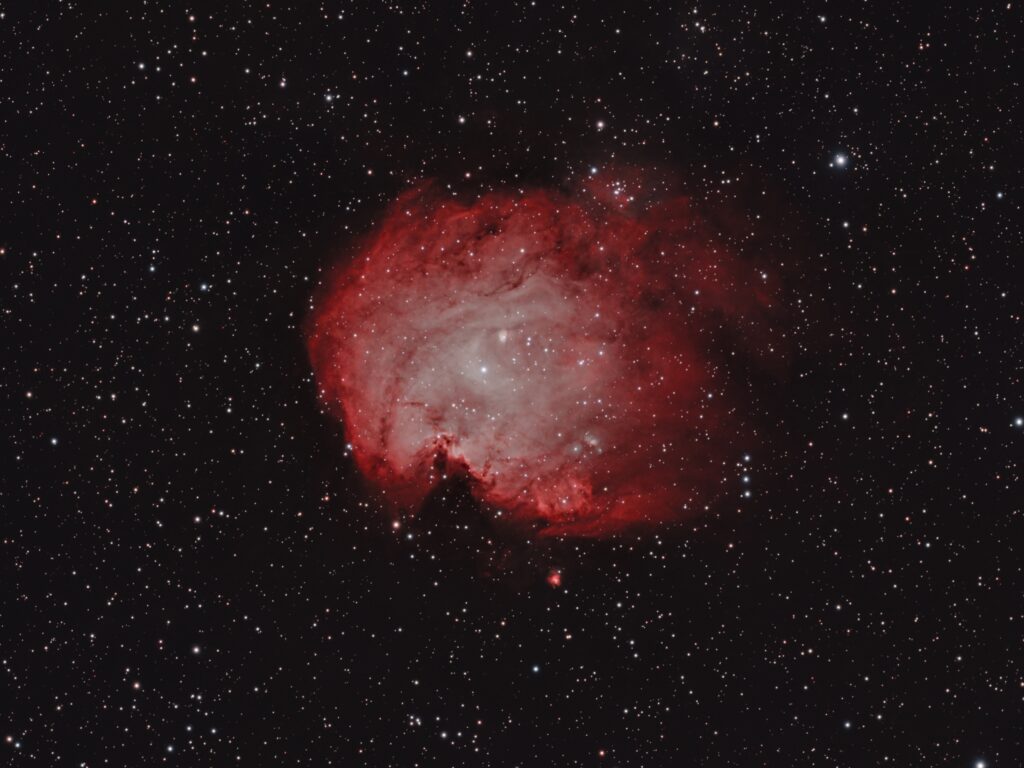
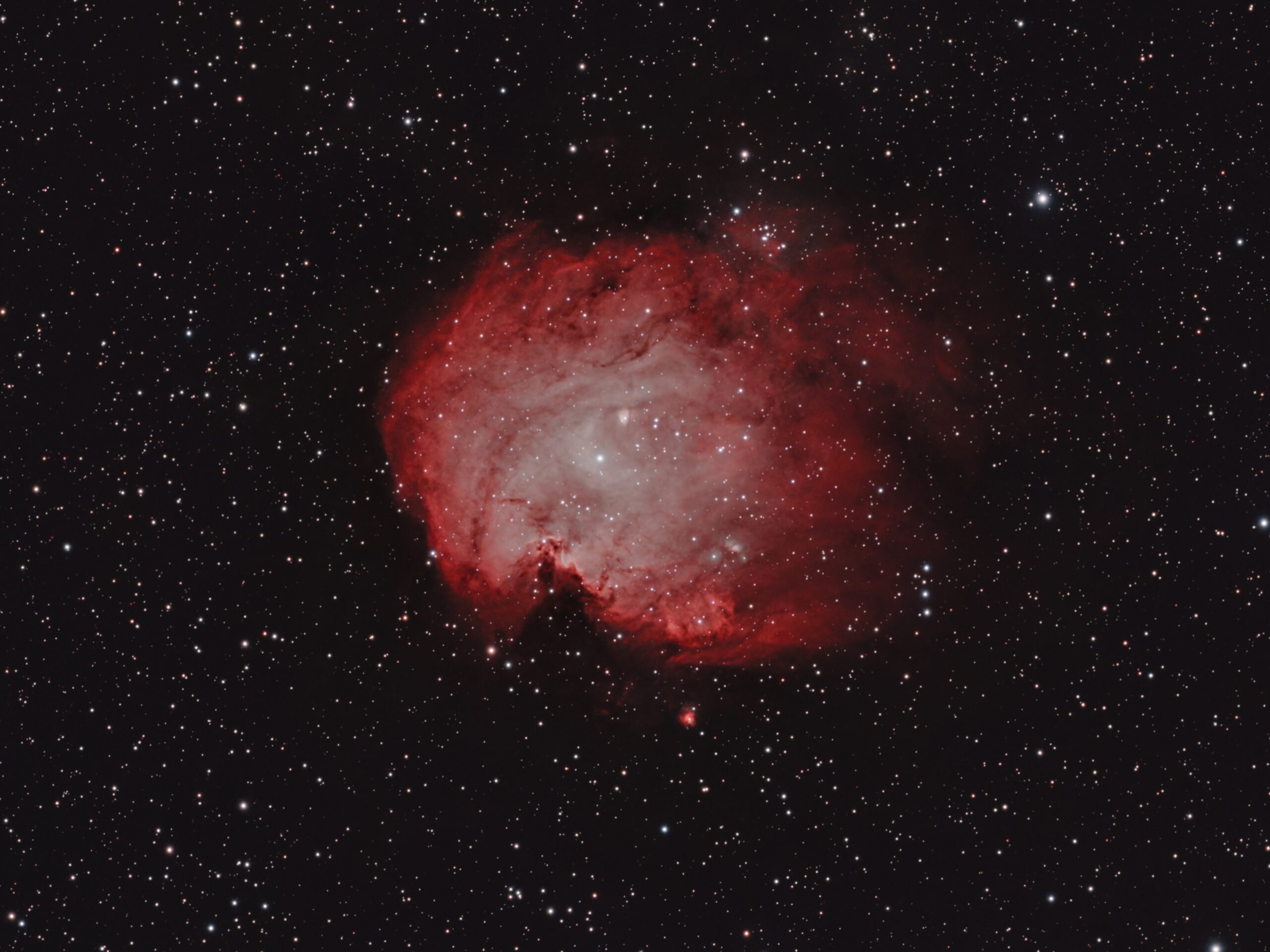
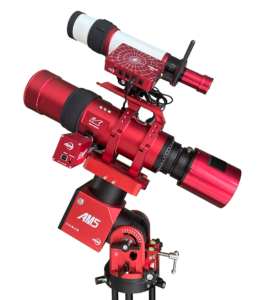
I set out to capture the Monkey Head Nebula (NGC 2174 in Orion) with my usual astrophotography setup, aiming for a gorgeous deep-sky image. I took 70 frames at 300 seconds each (about 6 hours total exposure) and stacked them to reveal the nebula’s faint details. However, something unexpected showed up: a bright object had drifted across those frames, leaving a streaky trail in the combined image. It turns out I had been photobombed by none other than asteroid Vesta – a hefty rock from the asteroid belt that wandered through my field of view.
Asteroids actually wander into my astrophotos fairly often. Normally, though, they’re just faint streaks that don’t make it through image stacking. When I stack dozens of long exposures in PixInsight, the software uses pixel-level rejection to clean up things that don’t belong — like satellites, planes, cosmic rays, and yes, small asteroids. It’s like a smart “cosmic eraser.” But Vesta is big and bright! Being one of the brightest asteroids in the sky, the statistical cleanup process could not hide it. Instead of vanishing in the stack, it left a glaring smudge right across my carefully planned nebula shot (see below!).

At first, I wasn’t sure what the odd smudge on my stacked image was. It didn’t match any celestial object I’d seen before, and it wasn’t part of the Monkey Head Nebula. To investigate, I used a feature in my processing software that flips through each individual frame like a stop-motion video (see below). Sure enough, I spotted a “star” creeping across the field, moving in a totally different direction than the background stars. That’s when it clicked — I had an asteroid in my shot. The smudge on the stacked image is the software’s failed attempt to remove the “unwanted” object. A quick check online for that date, time, and location confirmed it: I had captured Vesta, one of the brightest and largest asteroids in our night sky!
This asteroidal intruder is a fascinating object in its own right, deserving of the attention it grabbed. So, here are some cool facts about Vesta, the photobombing asteroid:
Meet Vesta, the Nebula Photobomber
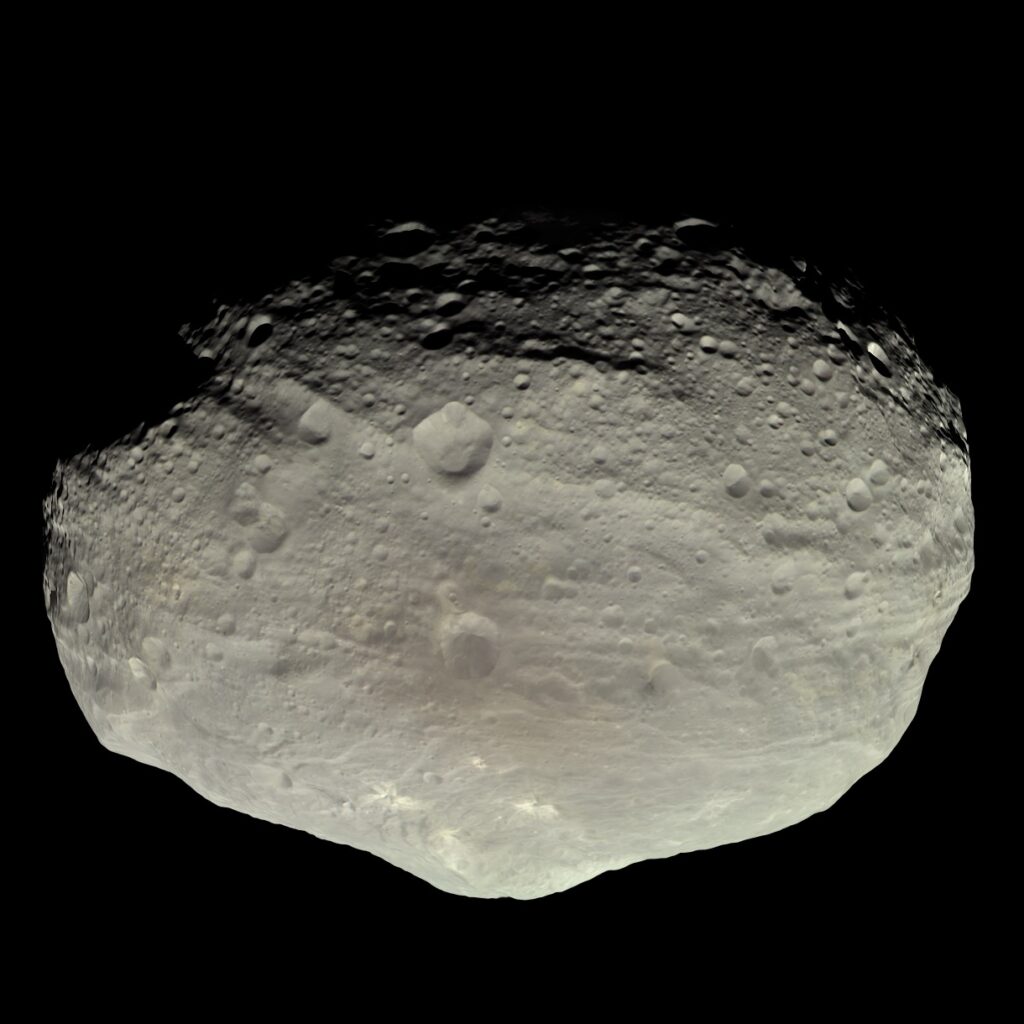
NASA’s Dawn spacecraft captured this full-color view of asteroid Vesta during its year-long orbit from 2011–2012. Dawn was the first mission to orbit two different bodies in the asteroid belt — Vesta and later dwarf planet Ceres — giving us unprecedented close-up looks at these building blocks of the early solar system. (NASA Planetary Data System)

Vesta Facts:
- Nearly 9% of the asteroid belt’s mass — Vesta is the second most massive object in the main asteroid belt, accounting for almost 9% of the total mass of all asteroids. Only Ceres beats it in mass. (NASA Planetary Data System)
- Differentiated like a tiny planet — Vesta has a core, mantle, and crust, much like Earth, a rarity among asteroids. (4 Vesta – NASA Science)
- Historic spacecraft visitor — NASA’s Dawn orbited Vesta from July 16, 2011 to September 5, 2012, mapping its surface and uncovering its secrets. (Vesta – NASA Science)
- Dramatic crater impact — Vesta sports a colossal crater named Rheasilvia (~500 km wide) on its south pole, nearly spanning the entire asteroid. (4 Vesta – NASA Science)
- Mapped in amazing detail — Dawn revealed Vesta’s geology, precise gravity field, and confirmed its role as the parent body of HED meteorites which account for nearly 5% of all meteorites. (Vesta – NASA Science)
Final Image
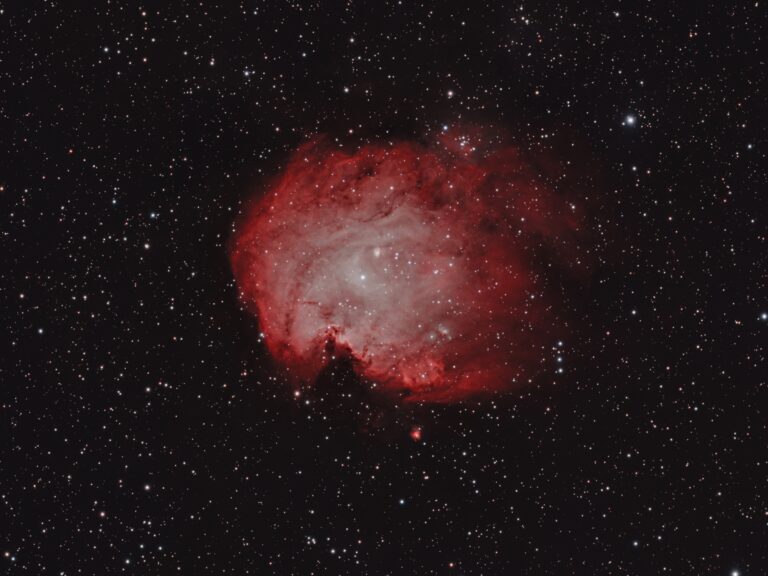
In the end, what started as a messed-up nebula image turned into a fun discovery. Vesta’s cosmic photobomb was a great reminder that when you’re aiming your telescope at the deep sky, you never know what you might find! In the end, I was able to “photoshop” out the asteroid-smudge so the final image of the Monkey Head Nebula looks clean (below). But I’ve always been more excited to share the short GIF of Vesta floating by!