
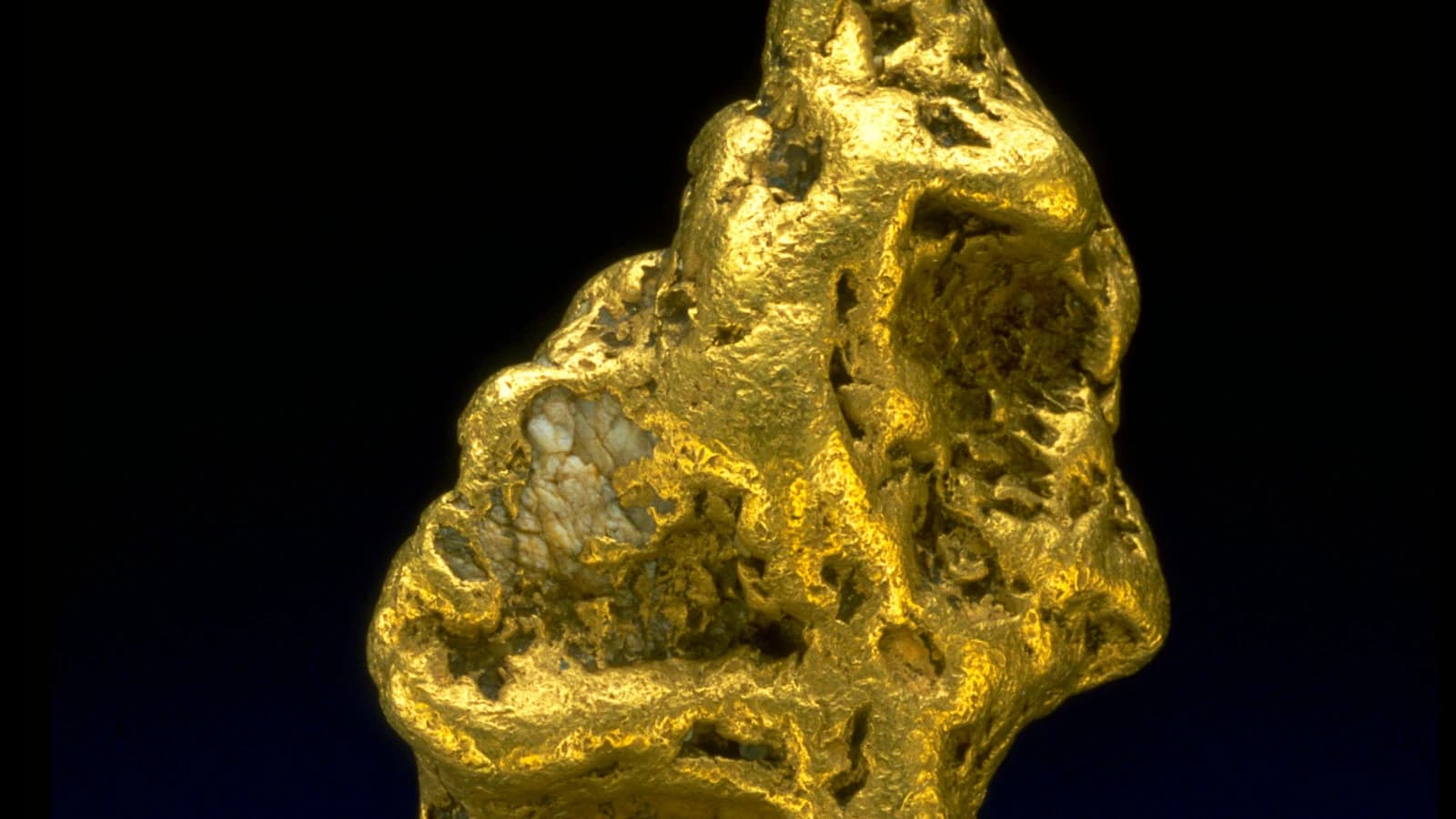
Where does the gold in a ring or nugget come from? Most people think it comes from Earth in roughly the same way a diamond does. It does not. Earth is where gold was buried, moved, and concentrated, but it is not where the element began.
The gold atoms themselves were already ancient when the solar system formed. The clearest route we have observed begins inside massive stars, passes through two neutron stars - each packing roughly a Sun's mass into a sphere about the size of a city - and ends in a collision that briefly changes the chemistry of the universe around it.
That is the part I find almost impossible to look past. A piece of gold is not simply a mineral pulled from the ground. It is the last visible stop in a journey that began before Earth existed.
This interactive follows that journey. Click, swipe, or use the arrow keys to move from the first star to the final nugget.
From a massive star to a gold nugget
Choose a step, use the arrows, or swipe the rail. I have kept the chain compact so the journey feels continuous.
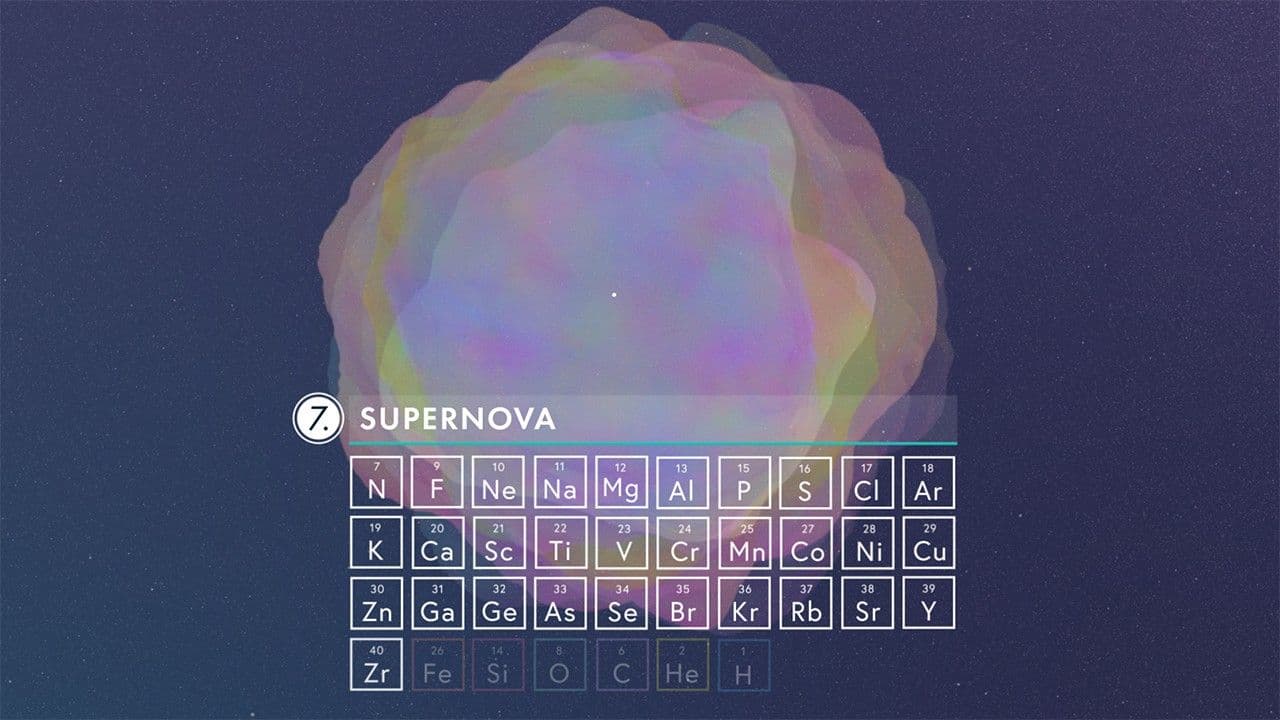
A massive star builds the ingredients
Gravity drives fusion through a sequence of heavier elements. The star can climb from hydrogen toward iron, but gold is still far beyond its reach.
- H → Fe
- the fusion ladder
- gravity
- the engine
- not gold
- the limit
Motion pauses automatically when reduced-motion is enabled.
What the 2017 collision actually showed
One correction matters because it is easy to compress this story too far: supernovae do not collide to make gold. A massive star can explode as a supernova and leave a neutron star behind. If two neutron stars remain bound, they can eventually collide.
On August 17, 2017, LIGO and Virgo detected gravitational waves from such a collision. Less than two seconds later, satellites detected a short gamma-ray burst from the same region of sky. Telescopes then found a new point of light in the galaxy NGC 4993 and watched it fade and redden over the following days.
That fading light was a kilonova: radioactive debris expanding and cooling after the merger. Astronomers did not hold up a spectrum with a neat gold label on it. What they saw was the broader fingerprint of freshly made r-process material, including direct spectroscopic evidence for strontium and later evidence for heavier, lanthanide-rich ejecta. The event showed that neutron-star mergers can manufacture and eject large quantities of elements heavier than iron - the family that includes gold and platinum.
There may be more than one cosmic forge. Rare, rapidly rotating supernovae with strong magnetic fields and giant flares from magnetars are serious candidates for contributing some r-process material, especially early in the Milky Way. But neutron-star mergers remain the clearest observed route and the cleanest backbone for this story.
What my image can - and cannot - show
My image of IC 443 shows the aftermath of a stellar explosion: thin, tangled filaments where a supernova shock is still moving through surrounding gas thousands of years later. A neutron star sits within this remnant, but neither it nor any individual heavy element appears in my photograph.
I am including it because it shows one real link in the chain. This is what remains when a massive star has blown apart and returned enriched material to space. The photograph is evidence of stellar death, not evidence that this particular remnant made the gold on Earth. That distinction makes the image more useful, not less.
Water did not make the gold
Once gold became part of Earth, a completely different process took over. Cosmic physics made the atom; geology made enough of those atoms gather in one place for us to find.
Deep underground, water can be heated by magma or hot rock. Under high temperature and pressure, that fluid can dissolve tiny amounts of gold with the help of sulfur- or chlorine-bearing compounds. Faults and fractures give the fluid a route upward. When it cools, loses pressure, boils, mixes with other groundwater, or reacts with the surrounding rock, its chemistry changes and the gold can no longer remain dissolved.
The gold precipitates onto the fracture walls, often beside quartz and sulfide minerals. Pulse after pulse of fluid can revisit the same crack and slowly build a vein. Water is therefore not the creator of gold. It is the transport system that takes gold scattered through a large volume of rock and concentrates it into a much smaller one.
From a vein to a grain - or a nugget
A vein is not necessarily the end of the story. Rock exposed at the surface expands, cracks, and weathers. Water and ice pry it apart. Chemical reactions weaken it. Gold is unusually resistant to corrosion, so it can survive while much of the material around it breaks down.
Gravity then begins another round of sorting. A stream can move small pieces of gold, but because gold is about 19 times denser than water, it tends to settle where the current loses energy: behind boulders, on inside bends, in gravel bars, and in cracks along bedrock. Repeated floods may remove lighter sand and leave the heavier grains behind. These concentrations are placer deposits.
Some pieces remain tiny flakes. Others become rounded as they move downstream. Under the right conditions, pieces can gather into nuggets large enough to hold. The river did not make their atoms, any more than the hot water did. It separated, moved, and concentrated them.
The oldest part is the part I cannot see
By the time gold reaches a hand, almost everything about it has changed except the nucleus itself. A star assembled the ingredients. A supernova left a neutron star. Two neutron stars spiraled together. Their collision drove rapid neutron capture. Pre-solar dust carried the result into the young solar system. Earth buried it; hot water moved it; rock recorded it; weather and rivers uncovered it.
A jeweler can melt and reshape gold without changing the element. Gold remains gold because every atom still has 79 protons. That quiet atomic identity is the thread through the entire story - and it began long before there was an Earth to mine.
Sources and further reading
NASA and Hubble visual credits are linked inside the interactive. The closing nugget photograph is available under the Smithsonian's CC0 Open Access program. My IC 443 photograph is credited to NightSkyLens.